
Why Most Small Businesses Feel Chaotic (And the Simple Framework That Fixes It)
July 19, 2026
By: AMG Assured Solutions
If you run a small business, you already know the feeling: too many browser tabs, a to-do list that lives partly in your head and partly on sticky notes, and a nagging sense that something important is about to slip through the cracks (or has).
This isn't a discipline problem. It's a structural problem.
Most small businesses don't fail to organize because they lack effort - they fail because they never built a system. They're reacting to whatever's loudest that day instead of operating from a clear, repeatable structure. The good news: fixing this doesn't require an MBA or an expensive consultant. It requires a framework simple enough to be regularly used.
The Real Cost of Disorganization
Before the fix, it's worth naming the cost. Disorganized operations don't just feel stressful - they show up as:
Lost revenue from dropped follow-ups, missed invoices, or double-booked commitments.
Wasted hours re-explaining things because nothing is written down.
Burnout from being the only person who "knows how everything works".
Stalled growth, because you can't hire or delegate into chaos - there's nothing to hand off.
The fix isn't more hustle. It's better scaffolding.
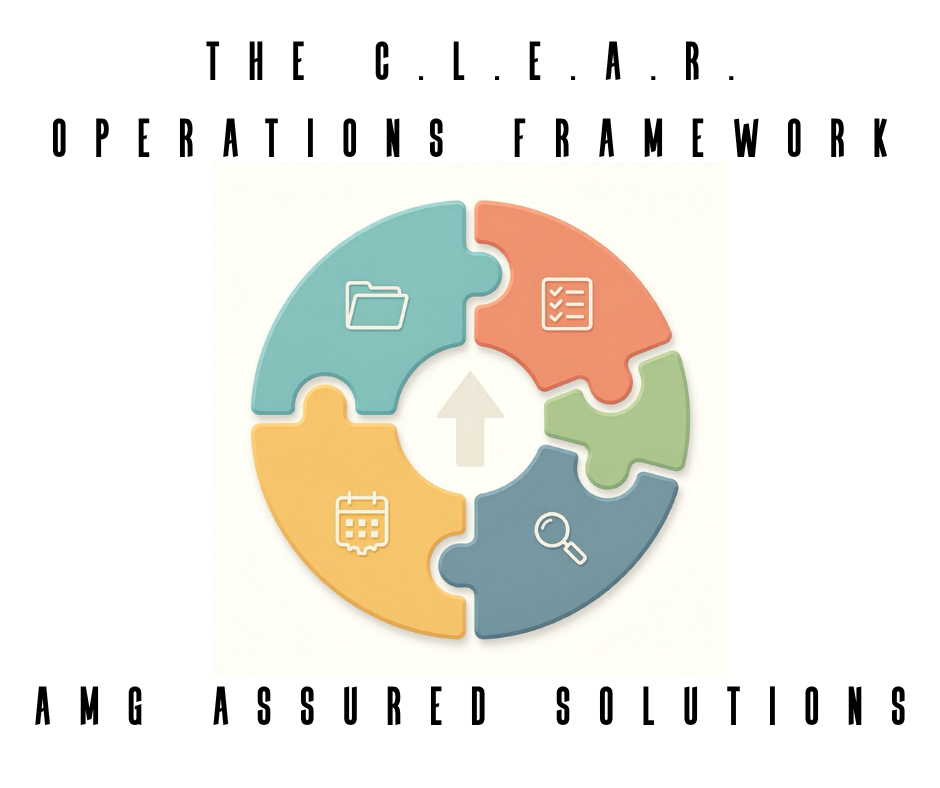
The C.L.E.A.R. Framework
Here's a simple, five-part framework for structuring small business operations. It works whether you're a solo operator or a 15-person team, because each piece scales with you.
C — Centralize Your Information
Pick one place for each type of information - one calendar, one task system, one document hub, one place where client info lives. The specific tool matters far less than the discipline of maintaining a single source of truth per category. If you find yourself asking where stuff is regularly - that's a centralization gap.
L — Lay Out Roles & Responsibilities
Even a two-person business needs clarity on who owns what. Ambiguity is where things fall through the cracks. Write down, in plain language, who's responsible for each recurring function - sales, fulfillment, finance, support - even if it's just you wearing every hat today. This becomes essential the moment you hire your first employee or contractor.
E — Establish Repeatable Processes
Any task you do more than twice deserves a simple written process - a Standard Operating Procedure (SOP). It doesn't need to be fancy. A numbered list of steps is enough. This is what lets you delegate without losing quality, and it's what keeps your business running smoothly when you're out sick or on vacation.
A — Automate and Equip
Once you know your roles and processes, you can pick the right tools to support them - a project management tool for task tracking, a CRM for customer relationships, an accounting platform for finances, and automation tools to handle repetitive work. Tools should follow structure, not replace it. Adding software to a disorganized process makes the chaos move faster and runs the risk of bad data/false information.
R — Review and Refine
Set a regular cadence - weekly or monthly - to step back and ask what's working, what's breaking, and what needs to change. Operations aren't "set and forget." A short recurring review keeps the system alive instead of becoming a binder nobody opens again.
Where to Start This Week
If this feels like a lot, start small:
Pick one messy area of your business (client intake, invoicing, onboarding - whatever causes the most friction).
Write down the current process, even imperfectly.
Apply the CLEAR framework to just that one area.
Expand to the next area once it feels solid.
You don't need to overhaul everything at once. You need one system that works, then a second, then a third.
The Bottom Line
Structure isn't the opposite of flexibility - it's what makes flexibility possible. A business with clear systems can grow, delegate, and adapt. A business without them gets chaotic and more fragile.
Use the full breakdown in the companion framework document to map out your own operations step by step, or let us help you!
Running a small business and want help implementing practical strategies and AI automations? We can help you! Schedule a FREE strategy call today!
Check out our Services and Packages options:
You can also follow us on social media to stay updated on events, discounts, tips, resources, and our community striving for the same goals!